ar
Muḥammad ibn Aḥmad Akansus
Profile dossier
Author
Roles
1
Related corpus
2 books
Biographical notice
Sidi Muḥammad Ben Ahmed Akensous
Sidi Muḥammad Ben Ahmed Akensous, whose full name is Sidi Muḥammad Ben Ahmed Ben Sidi Muḥammad Ben Younes Ben Mas‘oud al-Kansousi al-Qurashi al-Ja‘fari, was one of the great Moroccan scholars of the nineteenth century and one of the leading figures of the Tijāniyya. A jurist, man of letters, historian, textual scholar, and statesman, he stood out for the breadth of his learning and for his important role in defending the Tijani path.
Early Life and Lineage
He was born in the tribe of Tinmart in the Souss region in 1211 AH / 1796–1797 CE.
His lineage goes back to Ja‘far ibn Abi Talib, the cousin of the Prophet, which explains his nisba al-Qurashi al-Ja‘fari. He thus belonged to a noble family known for both social distinction and scholarly heritage.
Education
He began his studies at the Nasiriyya zawiya in Tamgroute, where he memorized the Qur’an and the major foundational texts. He later traveled to Fez in 1229 AH to continue his studies at al-Qarawiyyine.
In Fez, he studied under several of the city’s leading scholars and jurists. He lived in the Saffarine madrasa, and one of the notable details preserved about his stay there is that his room was next to the room once occupied by al-Jazouli, the author of Dala’il al-Khayrat.
He continued his scholarly formation at al-Qarawiyyine until 1234 AH, devoting himself fully to learning and intellectual refinement.
Public Career
In 1234 AH, Sultan Moulay Slimane summoned him and appointed him first as a secretary, then as a minister in 1235 AH, when he was only 24 years old. He remained in that position for three years before leaving it by his own choice in 1238 AH, shortly after the accession of Sultan Moulay Abd ar-Rahman ben Hisham.
This stage of his life reflects both his intellectual stature and his administrative importance in Moroccan public life.
Works
Sidi Muḥammad Akensous authored numerous works in history, literature, philology, jurisprudence, and scholarly polemics. Among his best-known writings are:
Al-Jaysh al-‘Aramram al-Khumasi fi Dawlat Awlad Mawlana ‘Ali as-Sijilmasi
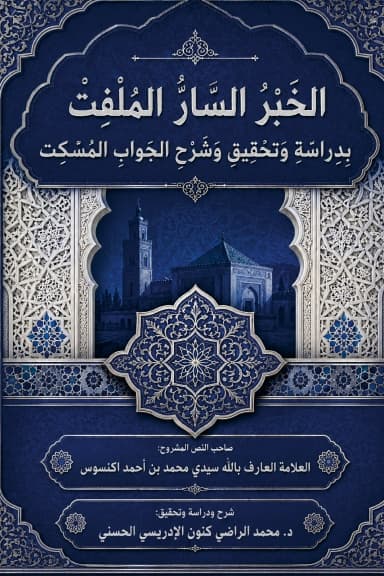
Al-Jawab al-Muskit – a response to those who criticized the Tijani path without proper knowledge
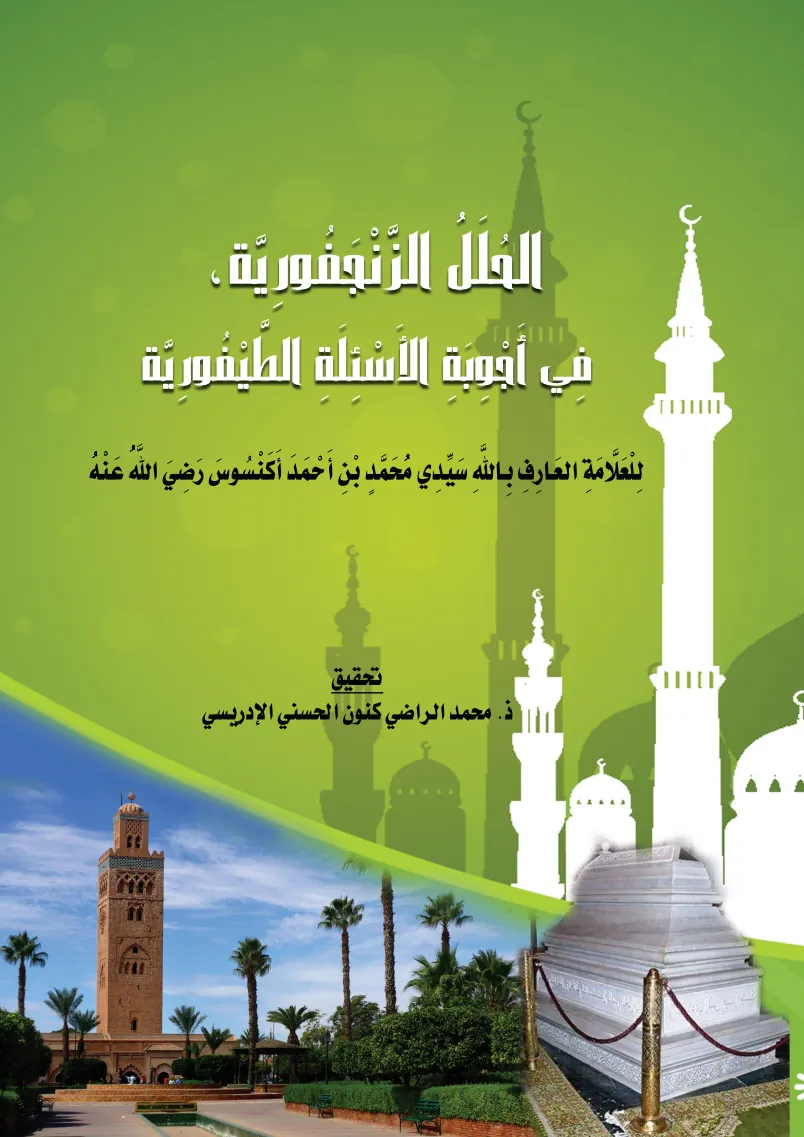
Al-Hulal az-Zanjafuriyya
a poetry collection arranged alphabetically
a work on the genealogy of the descendants of Ibn Idris
Al-Ajwiba at-Tunusiyya
Tashih al-Ghayth alladhi Insajama fi Sharh Lamiyyat al-‘Ajam
Al-Maqama al-Kansousiyya
a treatise on alchemy
his letters to the minister Muḥammad Ben al-Arabi al-Jam‘i
Khama’il al-Ward wan-Nisrin
Husam al-Intisar
Sharh Qasidat az-Zayyani
Al-Badi‘ fi ‘Ilm at-Ta‘dil
Tahqiq al-Qamus al-Muhit of al-Fayruzabadi
His work on the Qamus al-Muhit is especially noteworthy. He compared the text against around fifty reliable manuscript copies in a major philological effort that lasted more than two years and was completed in 1271 AH / 1854 CE.
Connection to the Tijāniyya Order
Sidi Muḥammad Akensous was one of the leading scholars of the Tijāniyya. His chain in the order passed through four major authorities:
Sidi Muḥammad al-Ghali Abu Talib al-Hassani al-Idrissi
Sidi Muḥammad (Fathan) Ben Abi an-Nasr al-‘Alawi as-Sijilmasi
Sidi Abdelwahab Ben at-Taoudi al-Fassi, known as Ibn al-Ahmar
Sidi at-Ṭayyib Ben Muḥammad as-Sufyani
All four had taken directly from Sidi Aḥmad al-Tijānī and were among his closest disciples.
Why He Entered the Tijani Path
He personally explained that he entered the Tijani path after hearing in Fez about the immense merit that God had prepared for its people, and after understanding that it was presented as the path of pure divine grace for a time in which people were no longer able to maintain the complete spiritual discipline of earlier generations.
He also recounts the powerful influence of the saintly ecstatic Sidi Ahmed al-Ghiwan, who repeatedly urged him to enter the path of spiritual knowledge. Eventually, he was taken to the Tijani zawiya on a Friday, and as soon as he entered, he heard a line of spiritual poetry that deeply moved him and marked the decisive beginning of his entry into the path.
Intellectual and Spiritual Profile
Sidi Muḥammad Akensous combined jurisprudence, literature, philological scholarship, history, public service, and spiritual formation. He thus represents a complete figure: a scholar, a statesman, and a man deeply rooted in the Sufi tradition.
Death
He passed away on the night of Tuesday, 28 Muharram 1294 AH, and was buried in Marrakech, outside Bab ar-Robb, near the shrine of Abu al-Qasim as-Suhayli.
He was 83 years old at the time of his death. His passing came almost exactly at the fortieth day after the death of his friend and companion in the path, Sidi Muḥammad Belqassem Basri al-Meknassi, as only 36 days separated their two deaths.
Legacy
Sidi Muḥammad Akensous left a major scholarly, literary, historical, and spiritual legacy. He remains one of the great Moroccan figures who successfully united learning, public service, doctrinal defense, and deep commitment to the Tijani tradition.