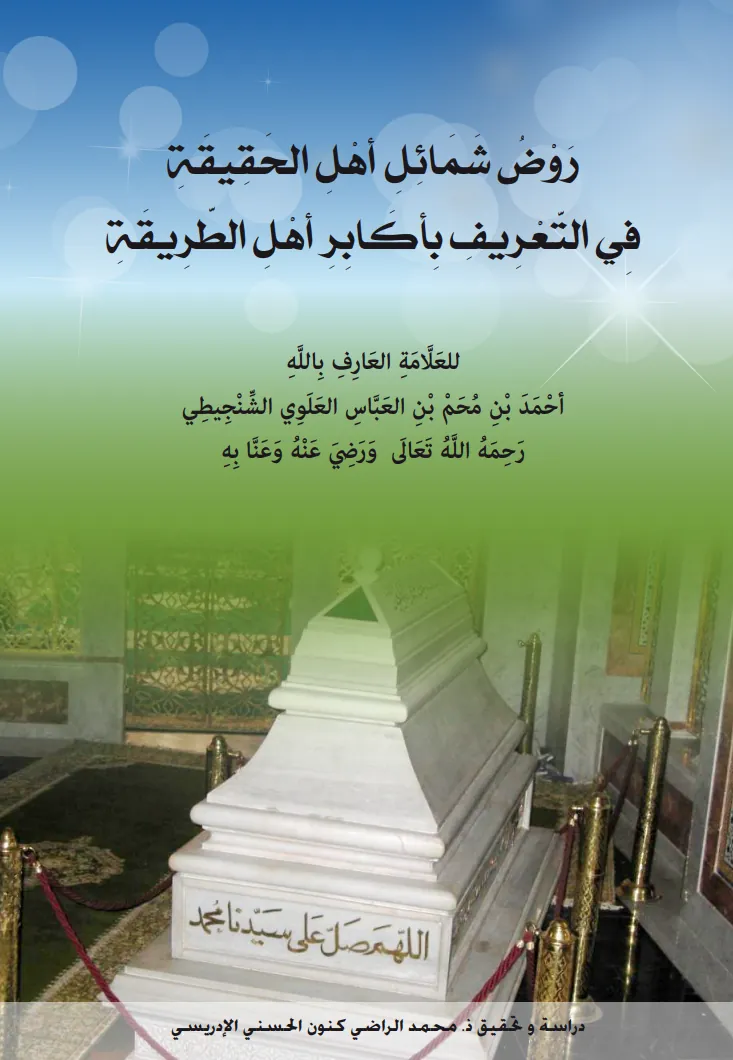
ar
Aḥmad bin Muham bin al-Abbas al-Alawi al-Shinqiti
Profile dossier
Author
Roles
1
Related corpus
1 books
Biographical notice
Sidi Ahmed ben Moham Alaoui Chenguiti
Sidi Ahmed Ham ibn al-Abbas Alaoui Chenguiti was one of the prominent figures of the large Tijani Alaoui family in the Chinguetti region. He was remembered as a scholar, a saintly man, and a respected spiritual authority, and much of what is known about him comes through the testimony of his son, the author of Rawd Shamāʾil Ahl al-Haqīqa fī al-Taʿrīf bi-Baʿḍ Rijālāt Ahl al-Tarīqa.
He belonged to a major Tijani family in Chinguetti, a family known for scholarship, piety, and noble lineage. The scholar Muhammad al-Hajjouji, in the fifth volume of Ithaf Ahl al-Maratib al-ʿIrfaniyya, described him in highly honorific terms as a great scholar, an imam, a perfected saint, a righteous realized man, and a source of blessing.
His son states in Rawd Shamāʾil Ahl al-Haqīqa that he personally saw in his father’s handwriting forms of Tijani invocations that are only entrusted to the elite of the elite, an indication of his father’s elevated spiritual station within the path.
In his homeland, Sidi Ahmed Ham was renowned for an extraordinary mastery of books and difficult scholarly مسائل. People of his region even gave him a local nickname suggesting that he could draw out what was hidden inside books, meaning that he could extract subtle rulings, difficult legal discussions, and intricate theoretical questions with unusual ease. He was especially known for solving complex intellectual and legal problems without visible strain.
He also paid special attention to recording rare fiqh questions and subtle juristic points, which enhanced his reputation as a scholar of precision and depth. During a period when the Tijani path was facing criticism and denial in some circles, local scholars would turn to him whenever they encountered troubling claims or accusations. He would answer them in a way that calmed hearts and reassured minds, reflecting both knowledge and wisdom.
One well-known account illustrates this clearly: when a strange statement was attributed to Shaykh al-Tijani and people thought no satisfactory response could be given, Sidi Ahmed Ham offered a subtle explanation rooted in the principle of spiritual secrecy and the discipline of withholding what is meant to remain concealed. The scholars present accepted and admired his answer.
His standing was not limited to scholarship. His son also reports that after his death, people would often hear Qur’anic recitation near his grave, especially at night, and that light was frequently seen coming from it. He further states that Sidi Ahmed Ham was killed unjustly as a martyr while performing the Duha prayer, and that he had remained in the same state of ablution from the night prayer through the dawn prayer and into that final prayer.
His grave became so well known that the cemetery itself was associated with him by name, which reflects the depth of his memory in the local spiritual consciousness.
It is also reported that his own father was likewise one of the righteous, known for guarding his spiritual secrets, constant fasting, and deep piety. Among the family accounts of saintly favor is a story of a lost camel that he symbolically restrained, later instructing its owner to return a strap belonging to another family, which was then recognized.
Taken together, Sidi Ahmed ben Moham Alaoui Chenguiti emerges as a major figure in the scholarly and spiritual history of Chinguetti, combining religious learning, juristic insight, Sufi refinement, and moral authority.